

Ernst Law Group

Ernst Law Group
The Evidence They Didn’t Have and the Evidence That Was Destroyed
From the outset, this was not a conventional trucking case. There was no 911 call. No official traffic collision report. No independent witnesses. What little documentation should have existed, the driver’s logs, was gone.
Federal regulations require commercial truck drivers to maintain electronic logging devices. The carrier and the defense driver admitted they weren’t using them. They were keeping paper logs instead. And when they learned of the crash, just two days after it happened, they threw the paper logs away.
Plaintiff Attorney’s, Danielle Miller and Nigel Whitehead, fought for and secured a CACI 204 jury instruction, allowing the jury to draw a negative inference from the destruction of the logs. But they didn’t stop there. They built a theory around what those logs would have shown: that the driver was fatigued. They argued fatigue to the jury and methodically got both of the defense’s own experts to discuss fatigue on the stand, lending the theory credibility the plaintiff’s team never had to manufacture on their own.
The defense’s position was straightforward: their driver had no contact with Emily’s vehicle and was traveling in the far-right lane. But without logs to account for the driver’s hours, rest periods, or condition at the time of the crash, that narrative had no foundation to stand on. What had been destroyed to protect the defense became, instead, the architecture of the plaintiff’s case.
Redefining the Injury: Why PTSD Is a Brain Injury
The defense had a simple argument on damages: Emily did not have PTSD. Their neuropsychologist administered the MMPI-3 and concluded she did not meet Criteria A: the diagnostic threshold requiring exposure to actual or threatened death or serious injury. What it didn’t say was that in the entire two-hour evaluation, he never once asked Emily the question that pertained to Criteria A.
Danielle and Nigel uncovered that omission. On the stand, they got the defense’s own expert to admit it. But winning the diagnosis battle was only part of the strategy. The bigger fight was over what PTSD actually is.
Emily’s treating psychologist had already diagnosed her with PTSD. When Danielle and Nigel spoke with the treating doctor, they recognized they needed more: not just a diagnosis, but a framework that would redefine how the jury understood the injury itself. They hired a neuropsychologist who administered the CAPS-5 structured interview, the tool the Department of Veterans Affairs calls the gold standard for diagnosing PTSD. His role wasn’t only to confirm the diagnosis, it was to explain to the jury, in plain terms, what PTSD does to the brain.

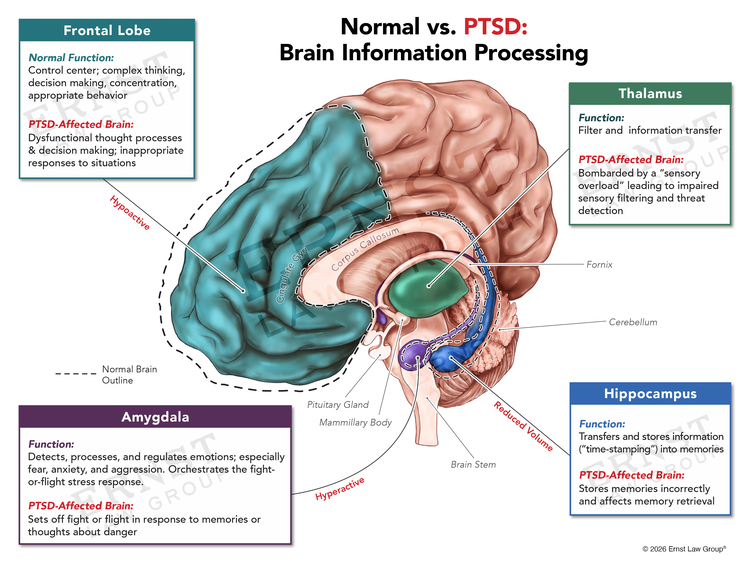
PTSD is not a measure of emotional distress. It is not a secondary diagnosis to a traumatic brain injury. It is itself a trauma-induced brain injury. PTSD can worsen a TBI by causing atrophy in the hippocampus and prefrontal cortex, increasing the severity of the injury and its potential long-term effects. Danielle and Nigel drove this point home with a medical illustration exhibit showing a normal brain alongside a PTSD brain. In one of the more remarkable moments of the trial, they got the defense’s own neuropsychology expert to get off the witness stand and use a pointer on their exhibit and explain what each atrophied region of the brain does, directly to the jury.
The defense had come to court to argue Emily wasn’t injured. They left having helped explain exactly how she was.
Proving What Can’t Be Seen: The Damages Case
With no soft tissue injury, no lost wages, no life care plan, and no future medical expenses, the damages case rested entirely on one question: what had PTSD taken from Emily’s life? Danielle and Nigel knew that answering that question required discipline and a deliberate choice about who should answer it.
Emily herself was on the stand for no more than fifteen minutes. Experience across jury trials had made one thing clear: plaintiffs are often the worst people to speak to a jury about their own damages. Instead, Danielle and Nigel built the damages case through the people around Emily: her treating psychologist, her neuropsychologist, her friends, her family and co-workers. All of whom testified to the substantial ways her life had changed since December 12, 2022.
None of it landed harder than the moment Nigel asked Emily’s husband to close his eyes. He asked him to picture his wife before the crash. In front of the jury, the husband said:
“I see my best friend fishing and camping in Bishop.”
Then Nigel asked him to picture her after.
“I don’t see my wife and my best friend anymore. I can’t see her now. She’s gone.”
He said it with his eyes still closed.
It was the kind of testimony no expert witness can deliver and no exhibit can replicate. It was the truth of what PTSD had done. NOT in clinical language, NOT in brain scans, but in the words of a man describing the absence of the person he loved most.
The Verdict
On May 19, 2026, after six days of trial and six hours of deliberation, the jury returned its verdict in Santa Monica’s Los Angeles County Superior Court before the Honorable Michael Young. The jury awarded $250,000 for past emotional distress and PTSD, and $2,000,000 for future emotional distress and PTSD. A total verdict of $2,250,000, with no comparative fault assigned to Emily.
The defense requested the jury be polled. Liability was 12–0. On damages, the vote was 10–2, with one of the two holdouts wanting to award more.
Aside from being a case no one thought could be won, it was Danielle Miller’s first case as first chair.
What Every Attorney Should Take From This Case
The verdict in Emily’s case was not an accident. It was the product of deliberate strategy, creative thinking, and a willingness to challenge assumptions that too many attorneys accept without question. For Attorney’s handling similar cases, the lessons are clear.
- Stop treating PTSD as a secondary diagnosis.
PTSD is not emotional distress with a clinical label. It is not a footnote to a TBI. It is a trauma-induced brain injury with measurable, physical consequences including atrophy in the hippocampus and prefrontal cortex, increasing the severity of the injury and its potential long-term effects. When you treat it that way, and when you find the right expert to explain it that way, the jury can too. Invest in a neuropsychologist who can administer the CAPS-5 and speak to the brain science. Bring the exhibit. Make the invisible visible.
- Know the Defense expert better than they do.
The defense neuropsychologist submitted a report concluding Emily did not meet Criteria A for PTSD. What his report didn’t disclose and what Danielle and Nigel uncovered, was that he never asked her the question. That single omission, extracted on cross-examination, undermined the entire defense damages case. Read every report carefully. Identify every gap. The most powerful moments in a trial are often the ones the other side never saw coming.
- Use their experts to make your case.
In this trial, the defense’s own experts discussed fatigue from the stand and explained the brain science of PTSD using the plaintiff’s medical illustration exhibit. This doesn’t happen by accident. Our trial lawyers always try to highjack the defense experts. See where there is common ground and get the defense expert to start out helping you. Here, getting the defense expert off the witness stand using a point on our exhibit and explaining what each atrophied region of the brain does was priceless.
- Fight for the spoliation instruction, then build a theory around it.
A CACI 204 instruction is a powerful tool, but it is only as powerful as the story you build around it. Danielle and Nigel didn’t simply argue that the logs were destroyed. They argued what the logs would have shown: a fatigued driver. Then they used that theory to shape every expert interaction that followed. Spoliation isn’t just a procedural win. In the right hands, it becomes the spine of the liability case.
- Be strategic about who speaks to damages.
Put the right people on the stand, not necessarily your client. Friends, co-workers, family, and spouses can speak to loss in ways that plaintiffs often cannot, particularly when the injury is invisible and the defense is working to minimize it. Emily’s husband, asked to close his eyes and describe the woman he married, delivered the most powerful testimony of the trial in two sentences. Build your damages case around the people who can show the jury what has been taken, not just tell them.
- First chair is earned, but it has to start somewhere.
This was Danielle Miller’s first case as first chair. It resulted in a $2,250,000 verdict, a 12–0 liability finding, and a lesson for the entire plaintiffs’ bar about how to try a PTSD case. The attorneys who push the law forward are the ones willing to take on the cases that aren’t supposed to be winnable.